Robot lawn mowers have been around for years, but 2026 feels like the moment they finally go mainstream. The move away from boundary wires toward fully wire-free systems has eliminated one of the biggest obstacles for buyers, and the latest generation of lawn robots is becoming easier than ever to use.
After seeing most major brands unveil their new models at CES, three clear trends stood out. It’s an exciting time for robotic mowers — and these are the key developments set to transform lawns everywhere this year.
#1. LiDAR-based navigation
The most eye-catching trend is the growing use of LiDAR for navigation. This technology has been a staple in robot vacuums for years, and it’s now making a strong move into robotic lawn mowers. LiDAR works by emitting pulses of light, measuring how long they take to bounce back from nearby objects, and using that data to create a detailed 3D map of the environment.
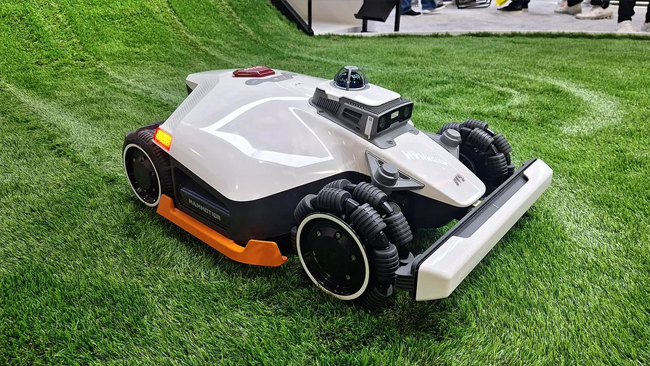
This makes it especially well-suited to smaller, enclosed gardens filled with obstacles. Unlike satellite-based systems, LiDAR doesn’t depend on a strong GPS signal, functions reliably under cover and in low-light conditions, and doesn’t require a separate RTK base station. In some cases, users can simply place the mower on the lawn and let it get to work immediately — a setup-free approach many brands are calling “drop and mow.”
At CES, nearly every major lawnbot manufacturer showcased at least one LiDAR-powered model. Examples included the Segway Navimow i2 LiDAR, Ecovacs GOAT LiDAR, Roborock X1 LiDAR, and Anthbot M5 LiDAR. Mammotion, meanwhile, is taking a hybrid approach by combining multiple navigation technologies — including LiDAR — so that if one system struggles, another can seamlessly take over.
That flexibility is important because LiDAR isn’t ideal for every situation. In large, open spaces with few objects, there’s little for the light signals to reflect off, making satellite-based navigation more effective. For smaller yards, however, LiDAR is an excellent fit — and by simplifying setup and improving reliability, it removes a major barrier to adoption. In that context, it has the potential to be a genuine game changer.
#2. All-wheel drive
Another major trend was the rise of all-wheel-drive (AWD) robotic lawn mowers. This setup brings a couple of clear advantages. First, it allows lawnbots to handle difficult, uneven terrain far more effectively. Much like a four-wheel-drive vehicle, powering each wheel independently improves traction and stability. Even if one, two, or sometimes three wheels lose contact with the ground, the robot can still maneuver itself free.
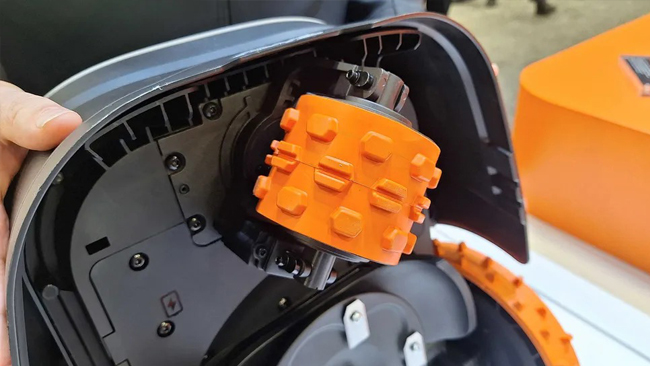
The second big advantage of AWD is that it can be kinder to your lawn. When wheels can move independently, the mower is less likely to tear up the grass while turning or pivoting. This is especially important in smaller yards where tight turns are common.
A good example of this approach is the Segway Navimow i2 AWD. It’s a compact, three-wheeled mower that isn’t designed for extreme terrain. Instead, its all-wheel-drive system is focused on protecting the grass in smaller lawns. The front wheel can rotate up to 180 degrees, allowing the mower to navigate sharp hairpin turns — the kind needed to create neat mowing stripes — without scuffing or dragging across the turf.
#3. Edge-trimming modules
One long-standing downside of robot lawn mowers is their inability to cut right up to the edges of a lawn. Traditionally, they’ve left a narrow strip untouched around the perimeter, meaning you still had to follow up with an edge trimmer to finish the job. That’s starting to change.
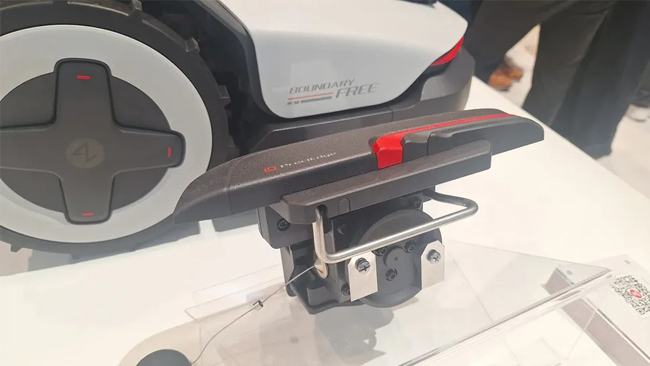
Many of the new models shown at CES feature dedicated edge-cutting solutions, either as built-in hardware or optional add-ons. These systems use smaller, secondary blades alongside the main cutting deck, allowing the mower to trim much closer to borders, paths, and fences with far greater precision.
These edge-trimming improvements depend heavily on advanced object detection — an area where robot mowers have made significant progress. Modern lawnbots increasingly rely on camera-based vision systems, often enhanced with AI, to accurately identify obstacles. This enables them to distinguish between areas that need mowing and objects that should be avoided, making precise edge cutting both safer and more reliable.