Disturbingly realistic humanoid robots are shaping up to be one of the defining tech themes of 2026, and a startup from Shanghai has just unveiled a machine that feels uncomfortably close to something out of Westworld.
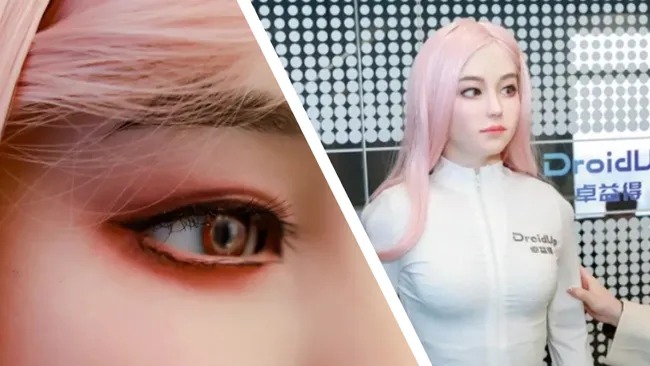
Thankfully, it’s still obvious that Moya is a robot. Her plasticky skin, lifeless stare, and slightly awkward movements make that clear. Yet a handful of unusual — and arguably creepy — design choices put her well beyond the average humanoid prototype.
For a start, Moya is warm to the touch. “A robot that truly serves human life should be warm — almost like a living being that people can emotionally connect with,” said Li Qingdu, founder of Droidup, in an interview with Shanghai Eye. Whether that’s reassuring or unsettling is debatable, but Droidup claims Moya maintains a body temperature between 32°C and 36°C (90°F–97°F).
According to the South China Morning Post, the company envisions Moya being deployed in healthcare, education, commercial environments, and even as a daily companion. Those ambitions explain why so much attention has been paid to making the robot feel physically lifelike.
That effort extends to the way Moya walks. Droidup claims her gait achieves a 92% accuracy rate compared to human movement — though how that figure is calculated remains unclear. Watching her shuffle cautiously forward, she looks more like someone recovering from an intense HIIT session than a confident pedestrian.

Still, the hardware behind her movement is impressive. Moya uses the “Walker 3” skeletal system, a successor to the robot framework that won a bronze medal at the world’s first robot half-marathon in Beijing in April 2025.
Moya’s realism doesn’t stop at motion. Cameras embedded behind her eyes allow her to interact with people and display subtle, human-like micro-expressions. Unsurprisingly, she also runs on AI, leading Droidup to describe her as the world’s first “fully biomimetic embodied intelligent robot” — a bold claim that leaves plenty of room for interpretation.
What’s undeniable is that robots like Moya show how AI is steadily escaping the digital realm and taking physical form, with increasingly convincing — and unsettling — results.
Despite the hype, humanoid robots remain far beyond the reach of ordinary consumers. Moya is expected to launch in late 2026 with a price tag of ¥1.2 million, roughly $173,000 / £127,000 / AU$248,000.
If realism alone were the goal, the crown might still belong to Xpeng’s IRON robot, whose fluid, model-like walk has sparked conspiracy theories that it’s actually a human in disguise. Those rumors were put to rest when IRON face-planted during its first public demonstration — a reminder that spectacular failures are still part of the humanoid robot journey.
CES 2026 made one thing clear: humanoid robots are nowhere near ready to casually roam our homes. Even the relatively affordable 1X Neo, priced at $20,000, only briefly looked like a solution to household chores.
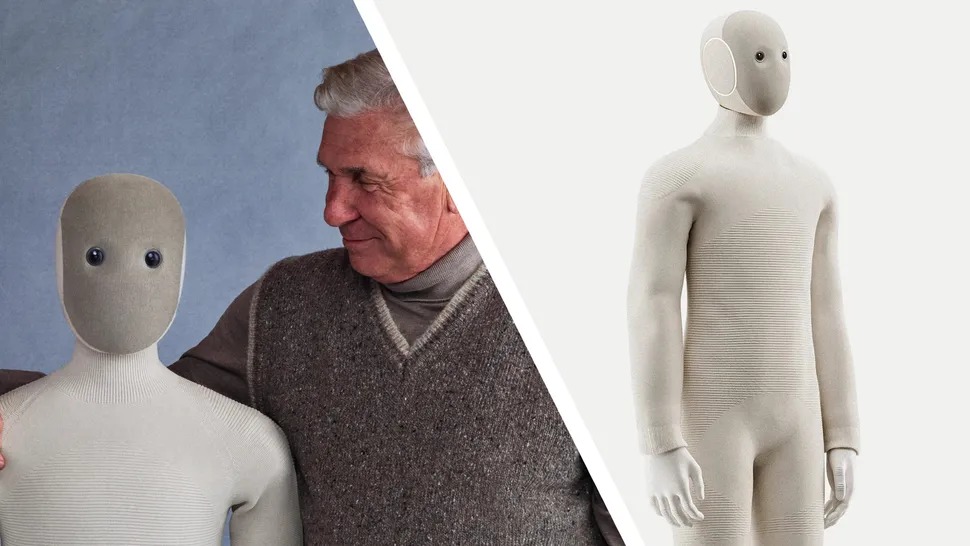
In reality, robots designed for home use don’t need warm skin, expressive faces, or near-human walking accuracy. Online commenters reacting to Moya’s debut were less than enthusiastic, with one writing, “If she takes two steps toward my bed, I’m throwing her off the balcony,” while another joked that she looks more like a burglar deterrent than a helper.
Instead, the first real-world roles for humanoid robots are likely to be in public service. UBTech Robotics has already secured a contract to deploy humanoids at the China–Vietnam border, where they’ll assist travelers — and conduct inspections. Droidup similarly sees Moya operating in train stations, banks, museums, and shopping malls, offering guidance, information, and customer assistance.
That may raise concerns for human workers, but for now, our most common household robots will continue to look far more like robotic vacuum cleaners than camera-eyed humanoids with warm skin and eerily human movements.