Samsung Galaxy Book6 Ultra Review: Panther Lake Finally Delivers the Best of Both Worlds
Samsung’s 16-inch Galaxy Book6 Ultra is the first Panther Lake–powered laptop I’ve used outside of a controlled demo, and it immediately makes a strong impression. Pairing Intel’s new Core Ultra Series 3 processor with discrete Nvidia graphics, this machine showcases just how far Intel’s efficiency and performance have come in 2026.
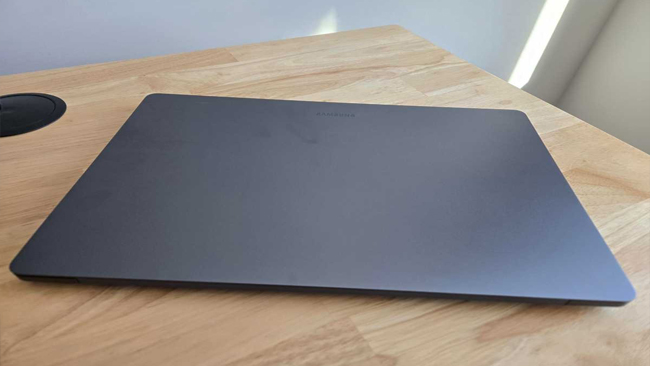
While Samsung hasn’t yet announced U.S. pricing or availability, the Galaxy Book6 Ultra clearly positions itself as a premium laptop. With over 24 hours of battery life, strong multithreaded performance, and dedicated Nvidia graphics, it delivers a combination that would have seemed unrealistic just a year ago.
A Modern Redesign for 2026
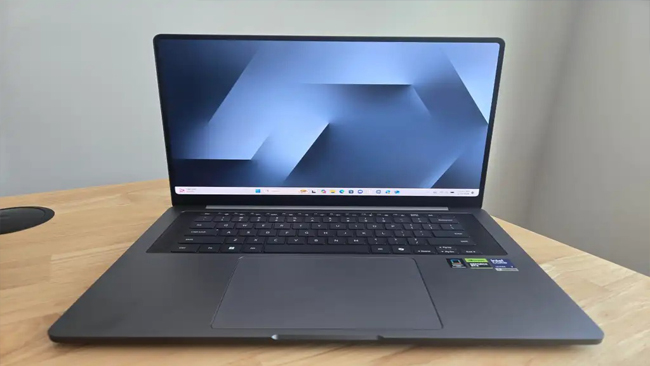
Samsung has refreshed the Galaxy Book lineup this year, and the redesign works in its favor. The 16-inch Galaxy Book6 Ultra removes the number pad found on last year’s model, allowing for a centered keyboard and trackpad. This change also frees up space for larger speakers on both sides, giving the laptop a cleaner and more balanced look.
The keyboard feels responsive and comfortable, though the key travel is slightly shallow — exactly what you’d expect from a slim premium laptop. Overall, the new design feels more modern and less utilitarian than previous Galaxy Book generations.
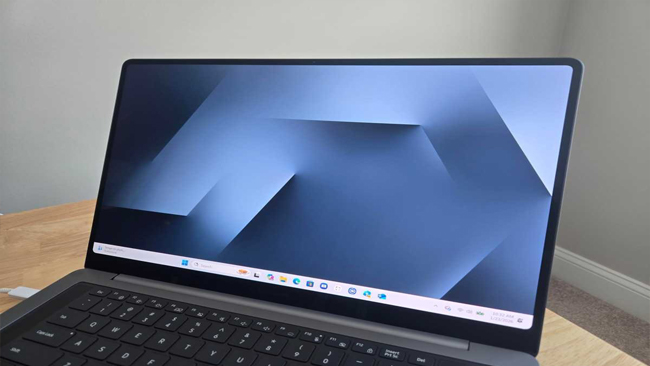
Samsung has also reduced the overall footprint. Older models, such as the Galaxy Book5 Pro, felt like large slabs of metal with tapered edges. The Galaxy Book6 Ultra opts for a more squared-off, compact design that makes it feel smaller and more refined, despite its 16-inch display.
Internally, Samsung has reworked the cooling system with redesigned fans and a vapor chamber to improve thermal performance. While the laptop feels sleeker, it doesn’t compromise on cooling — a welcome improvement.
Another notable upgrade is the haptic touchpad, which feels precise and modern. However, one disappointing omission is the lack of an IR camera for Windows Hello facial recognition. Instead, users will need to rely on the fingerprint reader.
Weighing just over four pounds, the Galaxy Book6 Ultra feels impressively light for a laptop with dedicated Nvidia graphics.
Excellent Display and Strong Connectivity
The review unit is equipped with an Intel Core Ultra 7 356H Panther Lake CPU, an Nvidia GeForce RTX 5070 GPU, 32GB of LPDDR5X memory, and a 2TB SSD.
The 16-inch AMOLED touchscreen is a standout feature, offering a 2880 × 1800 resolution, adaptive refresh rates from 30Hz to 120Hz, and up to 1,000 nits of peak HDR brightness. Colors are vibrant, contrast is excellent, and the panel works equally well for productivity and entertainment.
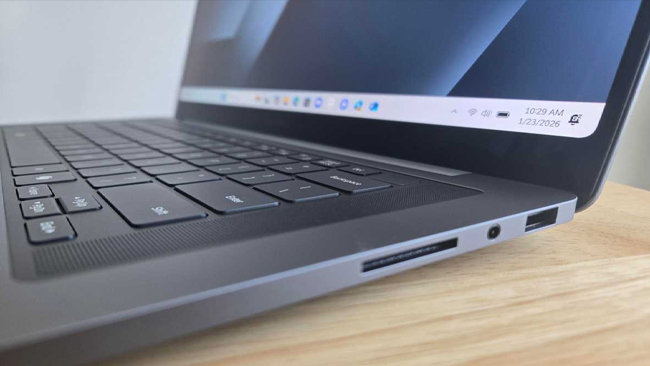
Port selection is solid: two Thunderbolt 4 ports, one USB-A port, HDMI 2.1, an SD card reader, and a headphone jack. Charging is handled via USB-C, though both Thunderbolt ports are located on the left side — having one on the right would have been more convenient.
Over 24 Hours of Battery Life — Even with Nvidia Graphics
Despite the powerful hardware and bright AMOLED display, the Galaxy Book6 Ultra exceeded 24 hours of battery life in an initial video loop test, landing at around 25 hours. That level of efficiency in a laptop with discrete Nvidia graphics is remarkable and highlights the strengths of Intel’s Panther Lake architecture.
Real-world usage will naturally result in lower battery life, but even so, this laptop remains exceptionally efficient for a system capable of gaming and running demanding professional applications when plugged in.
Samsung also claims fast charging, with up to 63% battery restored in just 30 minutes — a claim that appears realistic based on early testing.
Panther Lake Brings a Major Performance Leap
Intel’s previous generation Lunar Lake processors delivered impressive battery life but struggled with multithreaded workloads. As a result, many users were forced to choose between efficiency and performance.
Panther Lake aims to eliminate that compromise — and early results suggest Intel has succeeded.
In a HandBrake encoding test:
- A 2025 Galaxy Book5 Pro with a Lunar Lake Core Ultra 7 256V completed the task in around 1,433 seconds.
- The 2026 Galaxy Book6 Ultra with a Panther Lake Core Ultra 7 356H finished in just 671 seconds.
That’s more than twice the performance, while still offering improved battery life. Multithreaded workloads see the biggest gains, but performance improvements are noticeable across the board.
Final Thoughts: Intel’s Comeback Moment
The Samsung Galaxy Book6 Ultra is a polished, premium laptop that benefits greatly from its refreshed design. While the lack of Windows Hello facial recognition is disappointing, the overall experience is extremely compelling.
More importantly, Panther Lake finally delivers what Intel has been promising for years: strong performance and long battery life in a single x86 laptop. Previous Intel generations forced users
After only a few days of use, the Galaxy Book6 Ultra already feels like one of the most impressive laptops I’ve tested. It combines excellent battery life, serious performance, and full compatibility with traditional Windows software — no Arm limitations required.
If early impressions hold up in long-term testing, the Galaxy Book6 Ultra could easily rank among the best Windows laptops of 2026.